Arlington House Redesignation
Arlington House, the Robert E. Lee Memorial, is a National Park Service site inside the boundaries of Arlington National Cemetery.
Key historical facts include (read a two-page naming brief here):
Early federal managers of the site were transparent about slavery - Under the control of the Department of War until 1933, Arlington House displayed a frank account of American slavery in its entry hall in the late 1890’s.
The 1955 “permanent memorial” bill adding Lee’s name to the site was introduced amid the Civil Rights Movement - Rep. Joel T. Broyhill (R-VA) introduced the first bill designating a “permanent memorial to Robert E. Lee” in 1955. He opposed integration and signed the Southern Manifesto in 1956. He voted against the Civil Rights Acts of 1957 and 1964 and against the Voting Rights Act of 1965.
The 1972 name change was driven by one family’s lobbying, not public consensus - The current name came directly from a member of the Society of the Lees of Virginia, Eleanor Lee Templeman (a family historian, genealogist and author), who lobbied Congressman Broyhill and hand-delivered letters urging him to revive a stalled bill.
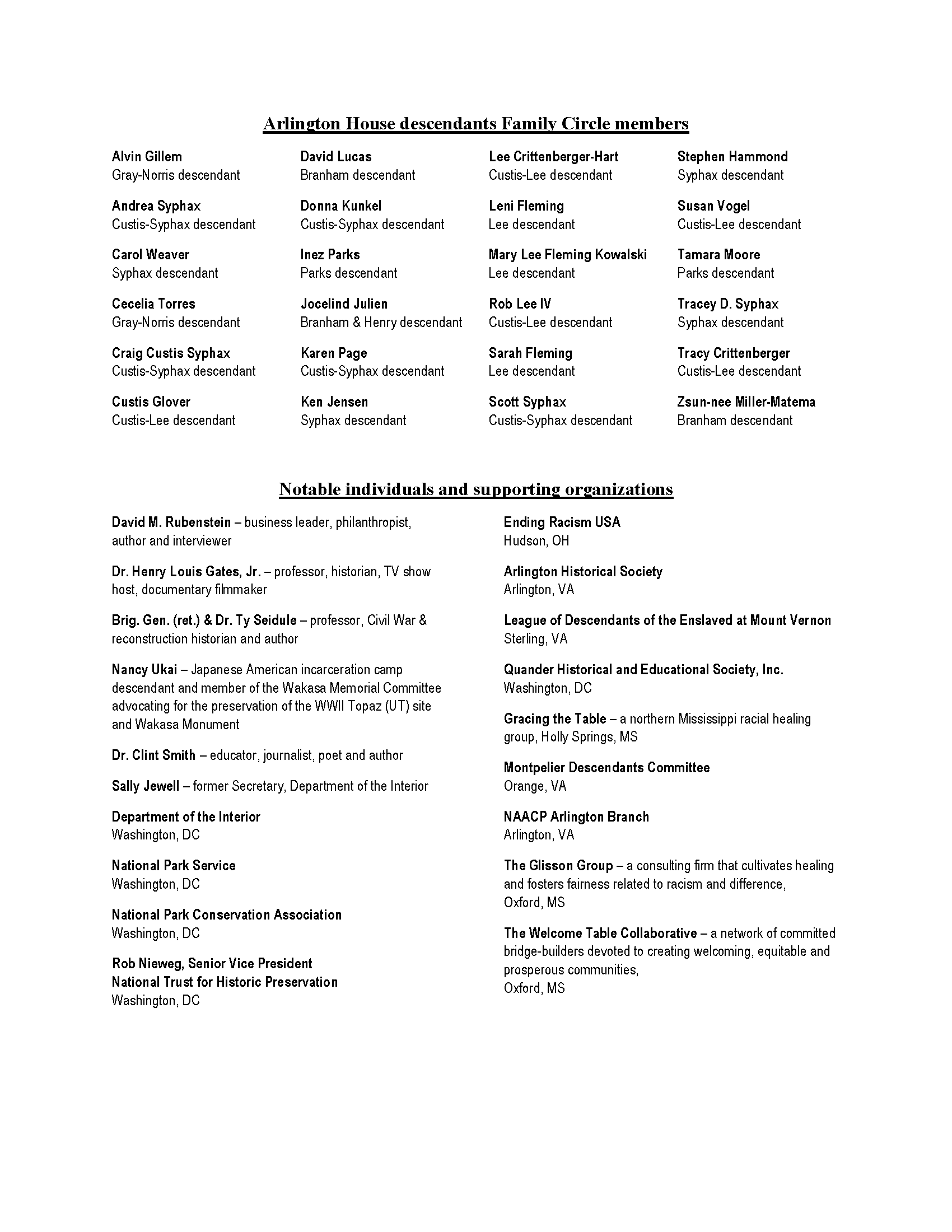
The descendants of both enslaved and free occupants at Arlington House have come together after more than 160 years to repair, heal and learn from one another. We request that Congress pass legislation to redesignate Arlington House, the Robert E. Lee Memorial as Arlington House National Historic Site.
The house was built between 1802 and 1818 by George Washington Parke Custis, grandson of Martha Washington, using enslaved labor, and was inherited by his daughter, Mary, who married Robert E. Lee in 1831.
Robert E. Lee never owned the property (Mary did) and resided there for about 8 years of the 30 years between the time he married and the time he resigned from the U.S. military to join the Confederacy.
The current name is not inclusive of the people nor the history of the plantation; Lee is definitely part of the history, but he is not the history of the Arlington House plantation.
There is support nationwide in the redesignation of the site; over 4,250 people have signed the change.org petition and a variety of notable individuals and organizations have written letters of support.

A Call to Action: How Can I Help?
Sign the petition to Redesignate Arlington House as a National Historic Site.
Add your name to the growing list of supporters. You’ll need to provide your name, city, state and zip code. Zip code is important for knowing which Congressional District you are located and who is your elected representative. You may be asked to make a donation to get more views of the petition. Don’t feel compelled to contribute unless you want to. A donation is not needed to sign the petition. However donations help change.org get the petition in front of addition people
Write to your members of Congress to express your support and to seek theirs. Use the ARCGIS Interactive Petition Mapper tool to see on a map where petition signers are geographically.
Tell others about the initiative and share this website with them.

Family Circle's Request of Congress
The Arlington House Descendants’ Family Circle letter to Congress begins:
“We, descendants with a history at Arlington House, endeavor to see this nationally significant National Park Service (NPS) site interpreted fully, precisely, and inclusively. We seek your support to redesignate the Robert E. Lee Memorial, located inside the boundaries of Arlington National Cemetery, as the “Arlington House National Historic Site.” The Arlington House, constructed between 1802 and 1818, was built for George Washington Parke Custis using enslaved labor and located on a 1,100-acre working plantation overlooking Washington, D.C.”
Read the full letter below or as a PDF.